
Edge Computing for Smarter Streets: Real-Time Intelligence on the Road
By Keith Heckel, DA Solutions Architect
You’re stuck at a red light. There’s no cross traffic. No pedestrians. Just a long, unnecessary wait while emergency responders a few blocks away are slowed by the same outdated system.
Now imagine a different kind of intersection. One that sees what’s happening in real time, adapts instantly, and helps keep traffic and first responders moving.
This isn’t a futuristic concept. With edge computing, it’s already happening.
By bringing computing power directly to the intersection, cities can rethink the way roadways operate. No more sending every piece of sensor data back to a distant cloud and waiting for a response. Instead, intelligent routers and switches process data on-site, enabling traffic systems to react to congestion, hazards, and even to people in real-time.
This shift isn’t just about technology, it’s about creating safer, smarter streets built for the pace of modern life.
How Does Edge Computing Work?
Edge computing is the practice of processing data close to where it’s generated, rather than relying on distant data centers or the cloud. In the context of smart transportation, this means placing computing power directly at intersections, traffic signals, and roadside infrastructure.
Why is that important?
Because timing matters. When a pedestrian enters a crosswalk or an ambulance needs to cut through traffic, even a few seconds of delay in data processing can have real-world consequences. Traditional cloud-based systems introduce latency and depend on reliable connectivity to central servers, neither of which are guaranteed in fast-moving or high-density urban environments.
With edge computing, traffic systems can analyze and act on data instantly and locally. That enables smarter decisions in real time, without waiting for instructions from the cloud.
So, what’s the difference between cloud computing and edge computing?
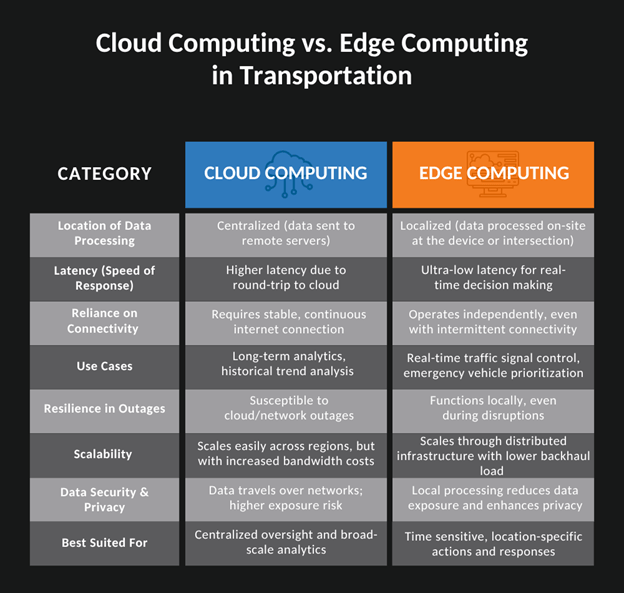
By turning roadside infrastructure into intelligent, autonomous nodes, edge computing transforms reactive traffic systems into proactive, self-adjusting networks. It’s not just an upgrade, it’s a foundation for the connected, responsive cities of the future.
Cisco at the Edge: Turning Intersections into Intelligent Nodes
To make real-time roadway intelligence a reality, you need more than just data. You also need the infrastructure to process it where it matters most. That’s where Cisco comes in.
Cisco’s industrial IoT routers and switches are purpose-built for the demands of connected transportation. Rugged, reliable, and secure, these devices are designed to operate in harsh roadside environments – from busy intersections to weather-exposed signal cabinets.
Once installed at key points in the transportation network – like traffic signals, crosswalks, roadside sensors, and even connected vehicles – these devices become local processing hubs. They collect and analyze data from cameras, radar, LIDAR, and other sensors on-site, enabling faster and more responsive actions without needing to wait on cloud instructions.
This decentralized model empowers transportation agencies to act faster, allowing greater control over local infrastructure without sacrificing visibility at the network level. Whether you’re upgrading a single intersection or connecting a city-wide grid, Cisco’s edge computing platform provides the scalability, interoperability, and intelligence needed to modernize mobility from the ground up.
Built-In Security and Scalable Design
Smart transportation networks can’t afford to trade agility for risk. That’s why Cisco’s edge computing solutions are built with security and scalability at the core.
All industrial routers and switches are equipped with enterprise-grade security, including encrypted data transmission, device authentication, and integrated threat detection. These safeguards ensure that sensitive data, from traffic patterns to emergency response signals, remains protected across the network.
Just as important is scalability. Whether you’re testing edge processing at a single intersection or expanding to cover an entire metro area, Cisco’s modular architecture makes it easy to grow at your own pace. Devices can be centrally managed, remotely updated, and integrated with existing systems, allowing transportation agencies to evolve their infrastructure without starting from scratch.
Cisco’s solutions are also built for interoperability and long-term growth. With support for open standards and a flexible software-defined architecture, they’re designed to adapt as new technologies, like AI-powered analytics and autonomous vehicle integration, emerge. You’re not just solving for today’s traffic; you’re preparing for tomorrow’s mobility.
The Road Ahead: Preparing for a Smart Transportation Future
Edge computing is more than an infrastructure upgrade. It’s a catalyst for the future of urban mobility.
In the years ahead, edge devices will serve as the connective tissue of smart cities, enabling infrastructure that can communicate not only with itself, but with vehicles, pedestrians, and emergency services. Cisco’s edge platform is already paving the way for innovations like:
- Connected Vehicle-to-Infrastructure (V2I) communication, where cars receive real-time updates from traffic systems
- Predictive analytics for accident prevention and maintenance scheduling
- Autonomous system integration, where roadside intelligence plays a critical role in safe navigation
As cities and states look to modernize transportation, edge computing will be essential to enabling the speed, coordination, and intelligence that 21st-century infrastructure demands.
Ready to See the Edge in Action?
Whether you’re managing a small pilot program or planning a city-wide rollout, Aspire has the edge computing tools and expertise to move your transportation systems forward safely and intelligently.
Explore our transportation solutions, talk to our experts, or see what edge computing can do for your infrastructure.